Creatine is one of the most researched supplements in sports nutrition, yet the same question comes up constantly: is it safe to take every day?
- It doesn’t harm the kidneys or liver in healthy people
- It’s not a stimulant, hormone, or steroid
- It’s naturally found in foods like meat and fish. Creatine supplements just help you get a consistent dose
What Is Creatine?
Creatine is a naturally occurring compound synthesized primarily in the liver, kidneys, and pancreas, and stored mainly in skeletal muscle. Your body produces roughly 1–2 grams per day on its own, and additional creatine comes from dietary sources like red meat and fish.
Its role in the body is specific and well understood: creatine helps regenerate adenosine triphosphate (ATP), the molecule that fuels short-burst, high-intensity efforts — think heavy lifting, sprinting, or explosive movements. When those stores run low, performance drops. Supplementation increases the reservoir.
Is It Safe to Take Creatine Every Day?
- Safe for men and women
- Works for beginners and advanced lifters
- Especially helpful for people who eat little or no meat
Do You Need a Loading Phase?
Not necessarily.
Loading (typically 20 grams per day split into four doses for 5–7 days) saturates muscle and stores faster (within about a week), but research shows that taking 3–5 grams daily achieves the same endpoint within three to four weeks. The difference is speed, not outcome.
If you want results quickly, loading works. If you prefer simplicity and want to avoid any initial water retention or digestive discomfort, skipping it is fine. Consistency matters more than the approach.
What Are the Benefits of Daily Creatine?
Does Creatine Cause Water Retention?
Yes, to a degree, and this is worth understanding rather than avoiding.
Creatine pulls water into muscle cells through a process called osmotic hydration. During the first one to two weeks of supplementation, particularly if loading, most people notice a weight increase of 1–3 pounds. This is intracellular water not subcutaneous bloating.
Over time, this effect stabilizes. Many athletes consider it a benefit, as higher intracellular hydration may support cellular function and reduce muscle breakdown during training.
When Should You Take Creatine?
Pick a time that fits your routine, with breakfast, post-workout, or alongside another supplement, and stick with it.
How Do You Choose a High-Quality Creatine?
This matters more than many people realize. The supplement industry is not uniformly regulated, and product quality varies widely. When evaluating a creatine supplement, look for:
- 100% creatine monohydrate
- Third-party testing certifications
- Transparent labeling
- No unnecessary additives — pure creatine monohydrate needs no fillers, artificial colors, or supporting ingredients to work
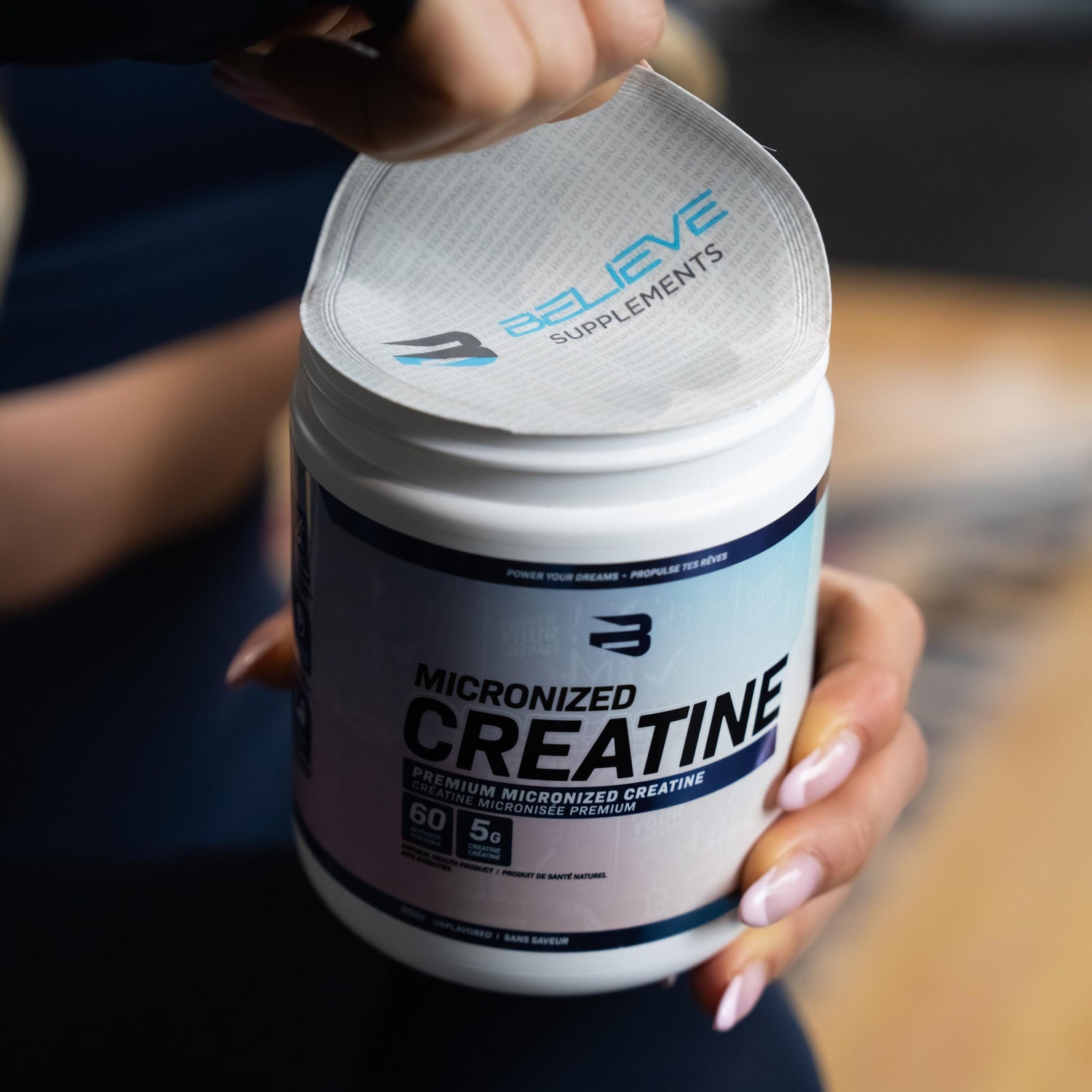
Believe Supplements offers micronized creatine monohydrate manufactured in Canada and verified through third-party testing. Customers can access publicly available batch testing results directly on the website.
You can access publicly the Third-Party Analysis directly on the website.

The Bottom Line
Creatine monohydrate is among the most studied and consistently supported supplements in sports nutrition. The research is clear: daily use at 3–5 grams is safe for healthy adults, effective for improving strength and high-intensity performance, and practical to sustain long-term.
It is not a shortcut, and it works best as part of a consistent training and nutrition program. But within that context, it is one of the few supplements where the evidence genuinely justifies the use.
Frequently Asked Questions
Can you take creatine every day? Yes. Daily supplementation is recommended because creatine saturates muscle stores gradually. Missing doses slows the process; consistency maintains it.
How much creatine should I take per day? Most research supports 3–5 grams of creatine monohydrate daily. Some larger individuals or athletes with higher training volumes may benefit from the upper end of that range.
Do I need a loading phase? No. A loading phase (20g/day for 5–7 days) reaches saturation faster, but the same result is achieved with 3–5 grams daily over three to four weeks. Loading is optional.
What is the best type of creatine? Creatine monohydrate is the most researched form and the one supported by the strongest evidence. Other forms have not demonstrated meaningful advantages and are often more expensive.
Is creatine safe for women? Yes. Creatine is one of the most studied and effective supplements and it’s just as beneficial for women as it is for men.
- Supports strength and workout performance
- Helps improve muscle tone and definition
- Aids in recovery after training
- Can enhance mental clarity and focus
- Does not cause bloating or bulkiness
🙅♀️ Myth Busting: “Creatine will make me bulky or cause weight gain.”
Sources: International Society of Sports Nutrition Position Stand on Creatine (2017, updated 2021); Rawson & Volek, Journal of Strength and Conditioning Research (2003); Lanhers et al., European Journal of Sport Science (2017); Stout et al., Journal of the International Society of Sports Nutrition (2013).